2026 USA Pickleball Rule Updates: Everything Players and Tournament Directors Need to Know
Whether you play recreationally on a Tuesday morning or compete in sanctioned tournaments every weekend, the 2026 USA Pickleball rule updates affect you. USAP releases an updated official rulebook each year, and the 2026 edition brings meaningful changes across serving, adaptive play, tournament conduct, and officiating standards.
We have put this guide together to break down every key update in plain language. You will learn what changed, why it matters, and how to stay on the right side of the rules starting in 2026.
What Is the 2026 USA Pickleball Handbook?
The 2026 USA Pickleball handbook is the official governing document for all sanctioned pickleball play in the United States. Published by USA Pickleball (USAP), it outlines legal equipment standards, court specifications, serve mechanics, scoring procedures, player conduct requirements, and officiating protocols.
Think of it as the constitution of American pickleball. Every sanctioned tournament, referee certification course, and competitive ladder must align with it. The handbook is updated annually, usually taking effect on January 1 of the new calendar year. Players, coaches, and tournament directors are expected to know its contents.
What Is the 2026 USA Pickleball Handbook? The 2026 USA Pickleball handbook is the official annual rulebook governing all USAP-sanctioned pickleball play in the United States. It covers serving rules, scoring standards, equipment regulations, adaptive divisions, and player conduct requirements. It takes effect January 1, 2026 and is available as a free download at usapickleball.org.
Are There Any New Pickleball Rules in 2026?
Indeed there are, several notable new rules and clarifications come into effect in the 2026 edition. The changes are not cosmetic tweaks. They reflect a sport that has matured significantly, now demanding greater consistency in officiating, broader inclusivity for adaptive athletes, and clearer boundaries around player behavior.
This is for those that just want a quick-reference summary of the biggest 2026 updates:
- Stricter serve requirements (mechanics and foot fault standards)
- Expanded adaptive and inclusive divisions (new Adaptive Standing Division, updated wheelchair rules)
- Revised tournament and conduct laws (pre-match authority, penalty escalation, line call standards)
- Official scoring standardization across all sanctioned events
Each of these is covered in detail below.
Stricter Serve Requirements in 2026
Pickleball serving rules has always been one of the most scrutinized aspects of pickleball, and the 2026 rules tighten the standards considerably. The core serve mechanics remain, but USAP has added more precise language around arm motion, contact point, and foot positioning.
What Changed in the Volley Serve
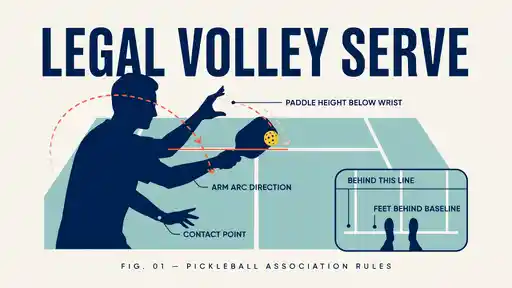
The volley serve, the traditional overhead-style serve performed without a bounce, now requires that the highest point of the paddle head be clearly below the wrist at contact. This was always the intent of the rule, but vague enforcement allowed some players to exploit a gray zone. The 2026 handbook eliminates that gray zone with tighter language and guidance for referees on how to evaluate the serve in real time.
The upward arc of the arm must be continuous and smooth. Any hitch, pause, or secondary motion in the swing can be called a fault. Referees at sanctioned events will receive additional training on identifying illegal serving mechanics under the 2026 standards.
Foot Fault Clarity
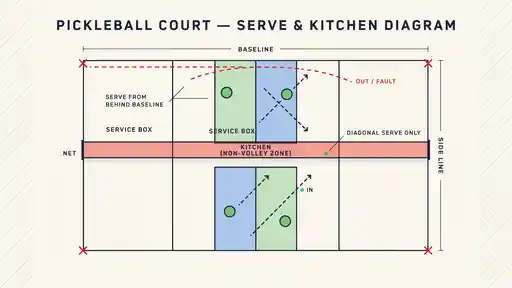
The 2026 update also addresses foot faults more directly. Both feet must be behind the baseline at the moment of serve contact. At least one foot must remain in contact with the playing surface. A player cannot be airborne at the point of contact. This sounds straightforward, but enforcement in competitive play has historically been inconsistent. The 2026 handbook gives referees clearer language to make confident calls.
Why These Changes Matter
Players who rely on powerful, unorthodox serves should take time to review their mechanics. Getting called for an illegal serve in a tournament is costly. Getting called for it repeatedly can result in escalating penalties under the 2026 conduct framework.
Is Drop Serve Legal in Pickleball in 2026?
Yes, the drop serve remains legal in 2026. It was made a permanent rule in 2022 after a trial period, and it continues in the 2026 handbook without significant restriction.
Using a drop serve technique, the player releases or drops the ball from any natural height without adding force to it. The ball must bounce on the playing surface before being struck. The key word is “natural.” You cannot throw the ball downward, spin it, or propel it in any direction before the bounce.
Once the ball bounces, the usual serve rules around the bounce serve relax. Unlike the volley serve, the drop serve has no requirements about the paddle being below the wrist or the arm moving in an upward arc. This is why many recreational players and beginners prefer it. It is also legal to drop the ball above shoulder height, as long as no added force is used.
So if you have been wondering whether drop serve is still your best option to avoid the stricter volley serve standards in 2026, the answer is yes. It remains a reliable, legal alternative.
Quick Answer: Is Drop Serve Legal in 2026? Yes. The drop serve is fully legal in 2026. The ball must be released without added force and allowed to bounce before being struck. No paddle height or arm arc restrictions apply to the drop serve.
Expanded Adaptive and Inclusive Divisions in 2026
One of the most meaningful developments in the 2026 USAP handbook is the formal expansion of adaptive and inclusive competition categories. Pickleball is one of the fastest-growing adaptive sports in the country, and USAP is responding with structural changes to support that growth.
The New Adaptive Standing Division
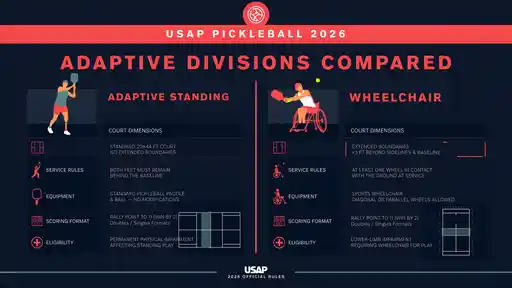
The 2026 handbook introduces the Adaptive Standing Division as a distinct competitive category. Previously, players with physical disabilities who competed in a standing position often had to enter open divisions or rely on tournament directors to make informal accommodations. That changes in 2026.
The Adaptive Standing Division is designed for players who have a qualifying physical impairment that affects their movement, balance, or limb function but who are not wheelchair users during play. Specific classification criteria are outlined in the handbook, and USAP is developing a formal classification process in partnership with adaptive sports organizations.
This matters for several reasons. It creates a competitive pathway where adaptive standing athletes are not disadvantaged against fully able-bodied opponents. It also opens the door to dedicated national rankings and championship brackets for this category.
Updated Wheelchair Rules
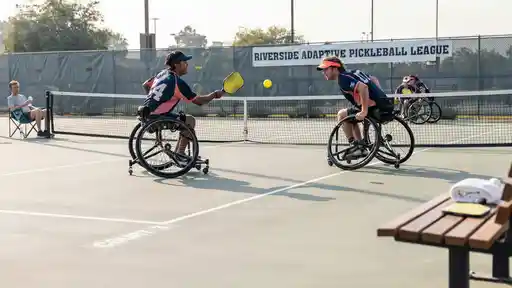
The 2026 edition also updates wheelchair division rules, primarily around the two-bounce rule. In wheelchair pickleball, the ball is allowed to bounce twice before a player must return it. This accommodation is not new, but the 2026 handbook clarifies how the two-bounce rule interacts with kitchen (non-volley zone) play.
Specifically, if a wheelchair player receives a ball that bounces in the kitchen, they are permitted a second bounce anywhere on the court before returning. The updated language removes ambiguity that had caused officiating disputes in competitive wheelchair events.
Tournament directors hosting wheelchair divisions should review the updated court setup recommendations in the 2026 handbook as well. Minor adjustments to accessible court access and chair positioning at the baseline are now standardized.
Tournament and Conduct Laws: What Is New in 2026?
The 2026 handbook brings significant updates to the rules governing tournament operations and player behavior. If you compete in sanctioned events, these changes have direct practical consequences.
Pre-Match Authority
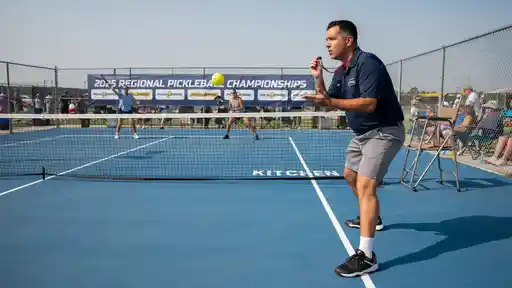
One of the clearest additions to the 2026 handbook is the formalization of pre-match referee authority. Under the 2026 rules, once a referee has been assigned to a match, that referee holds authority over the court area from the moment they arrive, not just from the first serve.
This means the referee can issue warnings, address conduct issues, and make rulings on equipment during warm-up. Previously, the pre-match window was something of a gray area where referee authority was implied but not codified. The 2026 language resolves this.
For players, this means your behavior during warm-up is subject to the same conduct standards as during match play. Verbal abuse, unsportsmanlike behavior, or equipment disputes happening in warm-up are now within the referee’s official jurisdiction.
Stiffer Penalties and Escalating Conduct Consequences
The 2026 handbook introduces a clearer escalation framework for conduct violations. Under previous rules, the path from a warning to a technical foul to a forfeit was not always consistently applied. The 2026 version standardizes this process.
The general escalation path works like this:
- A verbal warning is issued for a first conduct violation.
- A technical warning (which results in a point awarded to the opponent) follows a second violation.
- A technical foul (resulting in loss of serve and a point) is issued for continued violations.
- Repeated or egregious conduct can result in match forfeiture and possible suspension from the tournament.
USAP is also adding language around social media conduct related to in-match events. Making disparaging public statements about a referee’s calls during an active tournament can now factor into conduct reviews.
Line Call Standards in 2026
Line call disputes have long been a source of frustration in recreational and competitive pickleball alike. The 2026 handbook strengthens the standards for how players and referees handle these situations.
In non-officiated matches, the 2026 rules reaffirm that a ball is considered good (in) unless the player who is in the best position to see the call is certain it was out. Uncertainty defaults to the ball being in. This is not a new principle, but the 2026 handbook language is more direct about the certainty standard.
In officiated matches, players can now formally ask a referee to confirm or reconsider a line call if they believe the referee was not in the optimal viewing position. This is not a challenge system like professional tennis, but it creates a structured opportunity to request clarification. Referees are expected to acknowledge these requests and respond, even if the response is to confirm their original call.
What Is Considered an Out Ball in Pickleball in 2026?
An out ball in pickleball is any ball that lands outside the boundary lines of the court, including the area beyond the baseline, sidelines, or non-volley zone line when serving. In 2026, the definition of an out ball has not fundamentally changed, but the rules around calling it have been sharpened.
A ball that lands on any line is considered in, with one key exception: the non-volley zone line on a serve. If a serve lands on the kitchen line, it is a fault, meaning it is treated as out for purposes of the serve.
Here is a concise breakdown of out vs. in calls for 2026:
- Baseline: A ball landing on or inside the baseline is in. A ball past the baseline is out.
- Sideline: A ball on or inside the sideline is in. A ball outside is out.
- Non-volley zone line (kitchen line) on a serve: Landing on this line is a fault (out).
- Non-volley zone line during a rally: Landing on this line is in.
- Calling uncertainty: If you are not certain a ball was out, it is in. This standard is reinforced in 2026.
The 2026 handbook also makes clear that a player who calls a ball out must have a clear, unobstructed view of the shot. If your partner makes an out call and you had a better view of the ball landing in, your perspective should take precedence.
What Is Considered an Out Ball in Pickleball 2026? In pickleball 2026, an out ball is one that lands completely outside the court boundary lines, including past the baseline or sidelines. Any ball landing on a line is in, except a serve landing on the non-volley zone (kitchen) line, which is a fault. When uncertain, the ball is always called in.
Official Scoring Standardization in 2026
For years, informal scoring variations crept into recreational and even some tournament play. The 2026 handbook addresses this with official scoring standardization across all USAP-sanctioned events.
The Three-Number Scoring Call
The three-number scoring call remains the official standard: server score, receiver score, server number (1 or 2). Example: “4-2-1” means the serving team has 4 points, the receiving team has 2, and it is the first server. This has been standard for years, but the 2026 handbook reaffirms it as the only acceptable format in sanctioned play and requires referees to use it consistently.
Pre-Serve Score Announcement
Under the 2026 rules, in all sanctioned matches, the score must be announced before every serve, either by the server or the referee. Skipping the score announcement is now a procedural fault, not just an informal reminder. If a server fails to call the score and the referee does not catch it before the serve, a side-out or replay may be issued depending on the situation.
This change was driven by complaints from players who felt opponents were intentionally serving quickly to cause confusion over the score. The 2026 rule closes that loophole.
Time Between Serves
The 2026 handbook standardizes the time allowed between points. Players have 10 seconds from the moment the referee announces the score to serve the ball. In matches without a referee, the serving player should call the score promptly and serve within a reasonable time. Intentional delay is a fault under the 2026 rules and can escalate into a conduct violation.
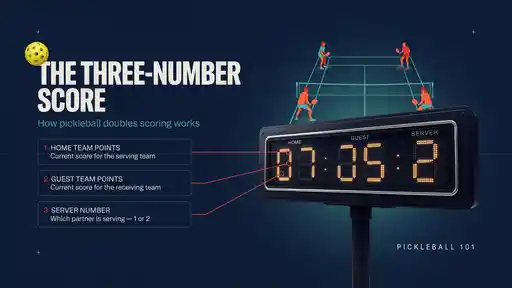
Image Integration Summary
| # | Placement | Subject | Alt Text | Caption |
|---|---|---|---|---|
| 1 | After serve section | Legal volley serve mechanics diagram | “2026 USA Pickleball legal volley serve diagram…” | “The 2026 USAP rulebook tightens serve mechanics…” |
| 2 | After wheelchair rules | Wheelchair division match photo | “Wheelchair pickleball players competing under 2026 USAP…” | “The 2026 USA Pickleball handbook formalizes…” |
| 3 | After adaptive intro | Adaptive division comparison infographic | “Comparison infographic of 2026 USAP Adaptive Standing…” | “2026 USAP introduces two distinct adaptive pathways…” |
| 4 | After pre-match authority | Tournament referee photo | “Tournament referee observing line calls during a 2026 USAP…” | “The 2026 USAP handbook gives referees formal authority…” |
| 5 | After out ball section | Court boundary diagram | “2026 pickleball court diagram showing in-bounds, out-of-bounds…” | “Understanding where balls land relative to boundary lines…” |
| 6 | After scoring section | Scoring sequence graphic | “Pickleball three-number scoring system example…” | “The 2026 USAP rulebook standardizes three-number scoring…” |
| 7 | Hero/top of article | Action photo of competitive play | “Players competing in a 2026 USAP sanctioned pickleball tournament.” | “The 2026 USA Pickleball rules bring major changes to serve mechanics, adaptive play, and tournament conduct.” |
| 8 | CTA section | Group of players on court | “Recreational and competitive pickleball players reviewing 2026 rules.” | “Whether you play recreationally or compete, knowing the 2026 USAP rules keeps you game-ready.” |
2026 USA Pickleball Rule Updates: Complete Guide – Summary
The 2026 USA Pickleball rule updates are more than administrative housekeeping. They reflect a sport that is growing up. Stricter serve requirements demand cleaner mechanics. The new Adaptive Standing Division opens a legitimate competitive pathway for athletes who have not had one. Tighter tournament conduct standards protect the integrity of the game at every level. And official scoring standardization removes one of the most common sources of on-court confusion.
If you play in sanctioned events, knowing these rules is not optional. If you play recreationally, understanding them makes you a better ambassador for the sport. Either way, the 2026 handbook is worth your time.
Ready to compete under the 2026 rules? Find a USAP-sanctioned tournament near you, or why not get yourself certified as a referee and help enforce the standards you just learned.
Rules last updated: January 2026. Always verify current rules at usapickleball.org, as USAP may release mid-year clarifications.